
MUSCLE-SPARING TOTAL KNEE REPLACEMENT WITH DR. WILLIAM AUSTIN
Preserve the muscle. Replace the knee. Recover with less disruption.
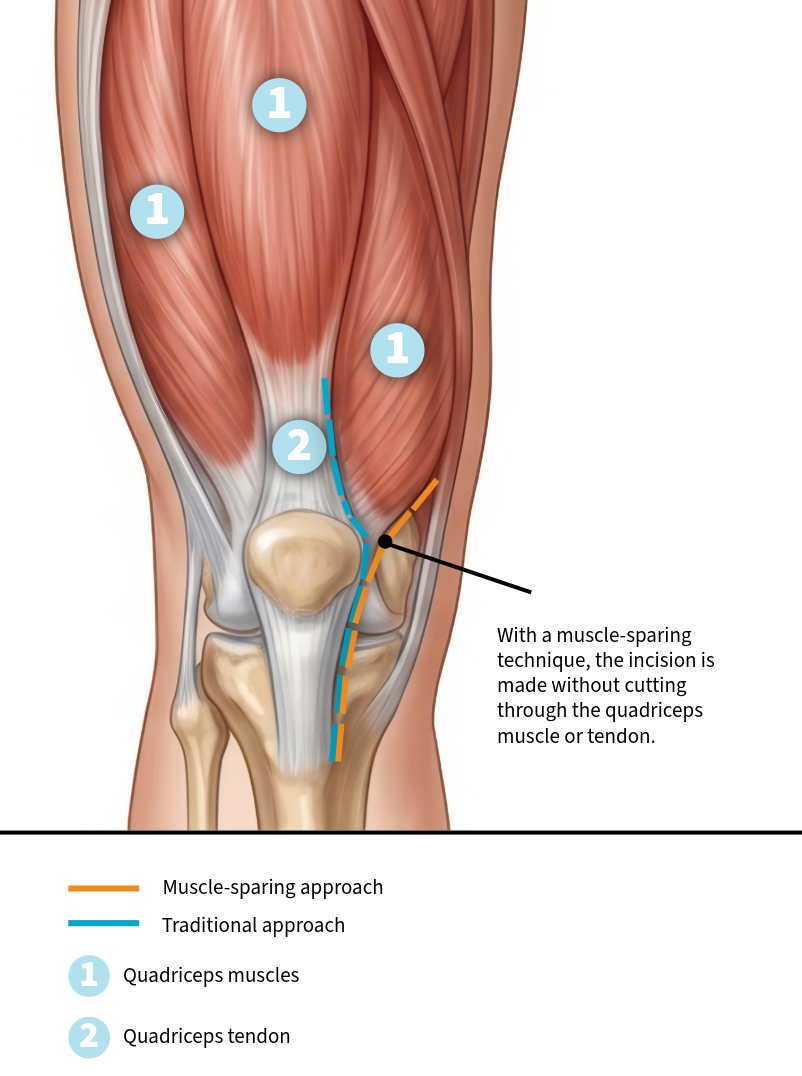
Traditional total knee replacement commonly requires an incision through the quadriceps tendon to expose the knee joint. A muscle-sparing (quadriceps-sparing) total knee replacement uses a modified surgical approach designed to perform the knee replacement while avoiding damage to the quadriceps muscle and tendon.
The goal is simple: perform an accurate, durable knee replacement while preserving the muscles and tendons that help you stand, walk, and recover.

Dr. William Austin
Board Certified Hip and Knee Replacement Specialist
Traverse City, MI
What Does “Muscle-Sparing” Mean?
Your quadriceps is the large muscle group on the front of your thigh. It connects to the kneecap through the quadriceps tendon and provides much of the strength needed to straighten the knee, stand from a chair, climb stairs, and walk.
In a traditional medial parapatellar knee replacement, the surgical exposure typically extends through a portion of the quadriceps tendon.
A quadriceps-sparing approach is designed to avoid cutting through the quadriceps tendon and minimize disruption of the extensor mechanism while still providing access to replace the damaged surfaces of the knee. AAOS Ortho-Info
Why Preserve the Quadriceps?
The quadriceps plays a major role in early recovery after knee replacement.
Preserving the quadriceps mechanism may provide potential early advantages such as:
- Less disruption of the muscles and tendon around the knee
- Less early postoperative pain in some studies
- Earlier return of quadriceps function
- Improved early range of motion in some studies
- Potentially easier early mobility and rehabilitation
- A smaller surgical exposure in appropriate patients
A meta-analysis of 19 randomized controlled trials found lower early pain scores with quadriceps-sparing approaches compared with standard approaches. PubMed Central (PMC)
Quadricep-sparing knee replacement has also been found to improve early range of motion and some measures of early recovery. PubMed
Precision Matters
One of the challenges historically associated with minimally invasive knee replacement has been performing an accurate knee replacement through a smaller surgical window.
Robotic Assistance Changes the Equation
Robotic-assisted knee replacement provides the surgeon with detailed information about the patient's anatomy, implant position, alignment and soft-tissue balance during surgery.
Modern randomized evidence shows that robotic-assisted knee replacement can improve the accuracy and consistency of implant alignment compared with conventional instrumentation. This results in substantially fewer mechanical-alignment outliers with robotic-assisted TKA. PubMed Central (PMC)
It is important to remember that the robot does not perform the operation. It is a precision tool used by the surgeon to plan and execute the knee replacement.
Potential Benefits
For an appropriately selected patient, a muscle-sparing approach may offer advantages during the early recovery period.
Preserve the Quadriceps
The approach is designed to avoid cutting through the quadriceps tendon.
Less Soft-Tissue Disruption
Less disruption of the extensor mechanism may make early mobility easier for some patients.
Early Range of Motion
Meta-analyses have reported improved early postoperative range of motion with minimally invasive approaches. PubMed
Early Pain
Studies show that muscle sparing knee replacement has demonstrated reductions in pain during the early post-operative period. PubMed Central (PMC)
Same-Day Surgery
Many appropriately selected patients can undergo modern total knee replacement as an outpatient procedure. AAOS notes that minimally invasive knee replacement can be performed on a same-day basis in selected patients.
Am I a Candidate?
Many patients with advanced knee arthritis may be candidates, but the approach is not appropriate for everyone.
Factors considered include the severity and pattern of arthritis, knee deformity, stiffness and range of motion, prior knee surgery, body habitus, bone quality, ligament stability, overall health and the complexity of the reconstruction required.
The priority is always to perform the knee replacement safely and accurately.
What Is Recovery Like?
Recovery varies considerably from patient to patient.
Physical therapy is required in the initial post-operative period typically consisting of 2 visits per week for 6 weeks.
Functional range of motion should be immediate with ideal range of motion at 6 weeks. Ideally this is 0 degrees to 120+ degrees, but this is patient dependent.
Muscle-sparing surgery is intended to reduce surgical trauma, but it does not make knee replacement painless or eliminate rehabilitation.
Patients should still expect swelling, temporary weakness, physical therapy and progressive improvement over weeks to months.
Physical therapy and regular movement remain important parts of recovery regardless of surgical approach. OrthoInfo
Individual recovery depends on factors including preoperative strength and mobility, age, medical conditions, severity of arthritis and participation in rehabilitation.
Frequently Asked Questions
Is Muscle-Sparing Knee Replacement Right for You?
The objective of knee replacement isn't simply to replace damaged cartilage.
It is to provide a well-balanced, accurately positioned and durable knee while minimizing unnecessary trauma to the tissues surrounding it.
For appropriately selected patients, a muscle-sparing approach offers another way to accomplish that goal while preserving the quadriceps mechanism.
Evidence & Patient Resources
American Academy of Orthopaedic Surgeons — Minimally Invasive Total Knee Replacement
Patient-focused overview of quadriceps-sparing and other minimally invasive approaches. OrthoInfo
AAOS Patient Resource
Yuan et al., BMC Musculoskeletal Disorders, 2019
Meta-analysis comparing quadriceps-sparing and traditional medial parapatellar total knee replacement. PubMed
View on PubMed
Kazarian et al., Journal of Arthroplasty, 2018
Meta-analysis of randomized controlled trials highlighting both the limited clinical differences and historical alignment concerns associated with quadriceps-sparing TKA. PubMed
View on PubMed
Peng et al., BMC Musculoskeletal Disorders, 2015
Meta-analysis of 19 randomized controlled trials evaluating quadriceps-sparing, subvastus and standard approaches. PubMed Central (PMC)
Read the Full Article
2026 Network Meta-analysis of TKA Surgical Approaches
Analysis of 42 randomized studies comparing conventional and minimally invasive surgical approaches. PubMed Central (PMC)
Read the Full Article
2025 Meta-analysis of Robotic-Assisted TKA
Twenty-one randomized trials involving 2,692 patients found improved alignment accuracy with robotic-assisted TKA, without consistent superiority in patient-reported outcomes. PubMed Central (PMC)
Read the Full Article
Medically reviewed/written by William A. Austin, MD
Board-Certified Orthopedic Surgeon
Fellowship-Trained in Adult Hip & Knee Reconstruction
Great Lakes Orthopaedic Center
Traverse City, MI